The Invisible Labor Behind the Mirror

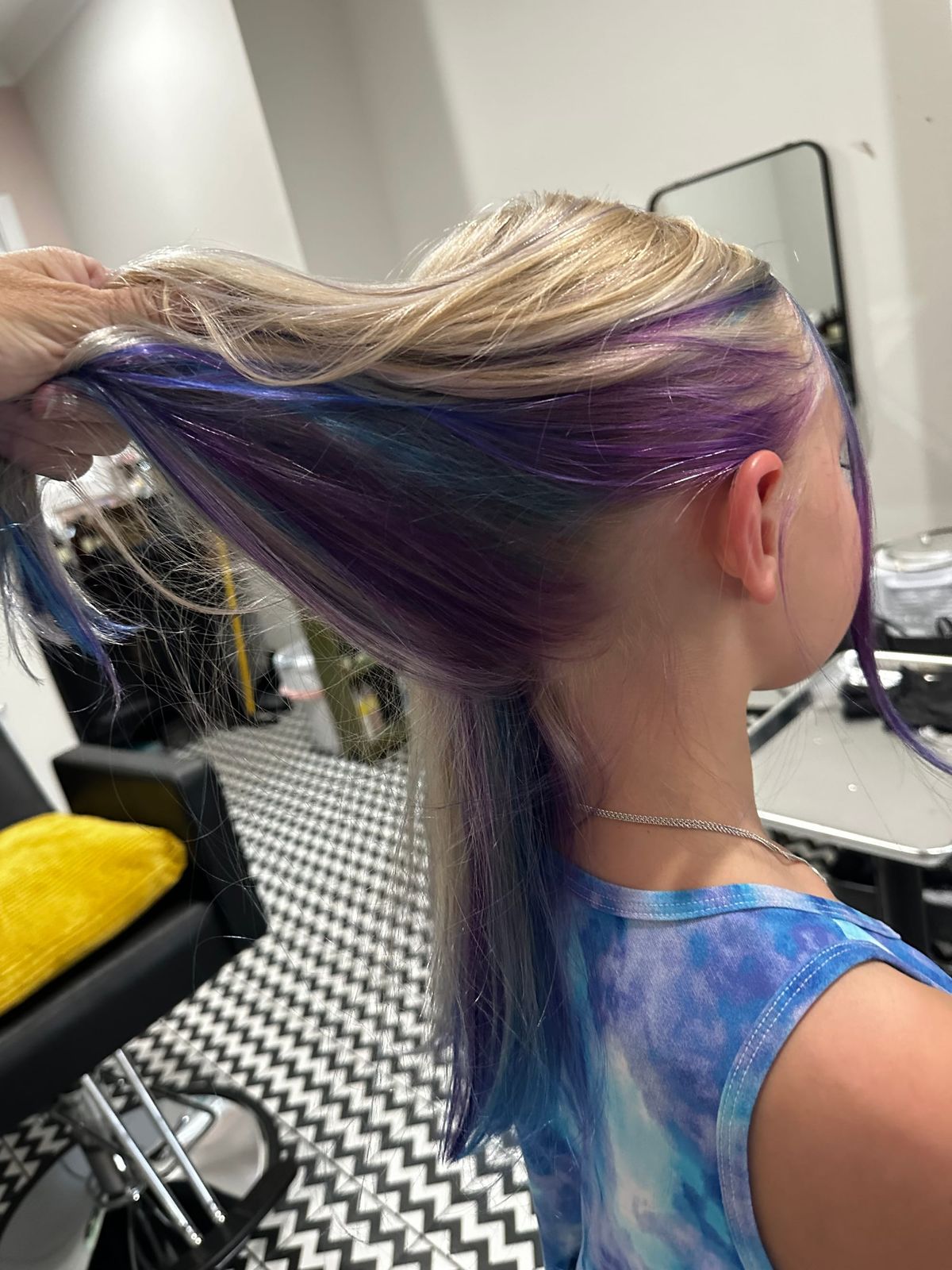
Doing hair is part science, part art, and part emotional weather report.
You may not know this, but my first love was not writing. It was doing hair. In fact, I still do it for a select few.
I've spent more than three decades standing behind a chair, mixing formulas, cutting angles, studying faces, and learning that what someone asks for and what someone actually needs are not always the same thing.
Sometimes it isn't really about the hair at all.
Hair color is measurable. We have levels and tones and formulas and ratios. We understand what happens when we add warmth, cancel warmth, cover gray, lift natural pigment, or put depth back into hair that has been highlighted for years.
But the way a person sees her hair isn't nearly as measurable.
Someone who has been very highlighted for years may decide she wants to return to something closer to her natural shade. We talk through keeping a few soft pieces around her face so the transition won't feel so dramatic. But maybe she's ready to be done with highlights altogether. So we formulate carefully—sometimes even lighter than her natural color—and use something that will fade softly rather than grab too dark.
And then she looks in the mirror and tells me she looks like Elvira.
Elvira, for the record, has jet-black hair.
She does not.
But that isn't really the point.
If you've spent years seeing bright blonde pieces around your face, a medium blonde can suddenly feel brown. A warm pendant light can make a cool color look red. Someone at the front desk can say, "I love that red on you," and suddenly red is the only thing you can see.
Then you go home.
Someone says, "Wow. That's different."
And now the hair you liked an hour ago doesn't feel quite the same.
That's part of the work we do behind the chair. We're not just reading formulas and watching processing times. We're reading faces. We're listening for hesitation. We're watching someone's expression when she first sees herself. We're trying to figure out whether the change in front of us feels exciting to her—or frightening.
But after all these years, I've learned there is another kind of reading we do, too.
Sometimes, if we're really paying attention, we realize the hair isn't the thing that needs the most attention that day.
There are times when I physically turn the chair away from the mirror.
I spin my client around until we're face to face. I bend down so we're eye to eye, and I give her my full attention.
Because sometimes she doesn't need to be seen in the reflection.
She needs to be seen by another person.
I want her to see how I see her.
Not through a mirror where she might be studying every gray hair, every line, every perceived flaw or every part of herself that has changed. I want her to see the face of another human being looking directly at her.
Because we don't look at the people we care about the way we look at ourselves in a mirror.
We see the whole person.
Sometimes a client needs a listening ear. Sometimes she needs reassurance or validation. Sometimes she needs to laugh. Sometimes she needs a hand on her shoulder. And sometimes she needs someone to step into her world for an hour and simply listen.
She needs to know that during the time she has in my chair, I am there.
Fully there.
Over the years, people have sat in front of me through marriages and divorces, babies and empty nests, new jobs and lost jobs, illness, aging, celebrations, heartbreak and grief.
They've told me things they haven't told other people.
I've watched children grow up through their mothers' stories. I've watched relationships begin and end. I've watched women lose people they love. I've watched them walk into the salon carrying things far heavier than anything I could fix with a pair of scissors or a bowl of color.
And sometimes they still want their roots done.
Maybe that's the point.
Life can be falling apart, but for a couple of hours you can sit in the same chair, with the same person you've known for years, and do something wonderfully ordinary.
We can talk.
Or not talk.
I can wash your hair. Mix your color. Hand you a cup of coffee. Put my hand on your shoulder.
And for a little while, you can just be here.
But there is another side to all of this, and it's one I have to remind myself of even after all these years.
Sometimes I'm busy.
Sometimes my mind is somewhere else. I'm thinking about what I need to do when I finish work, something happening in my own life, the next appointment, or one of a hundred things competing for space in my head.
I'm there. I'm listening. I'm doing the hair correctly.
I'm mostly present.
But I'm not completely present.
And they know.
People know when you're looking at them but not quite seeing them. They know when you're listening but part of you is somewhere else. And when someone has trusted you with this small, strangely intimate piece of her life for years, that missing little bit of attention can land much harder than you realize.
It can be a gut punch to the soul.
Something feels different.
Maybe she can't even name what it is.
Then she gets into her car and catches herself in the rearview mirror.
The color looks different.
She gets home and looks again.
Something isn't right.
Maybe the hair really does need to be changed. Sometimes it does. We are human. Hairdressers make mistakes, and part of being good at this job is being willing to own them and fix them.
But sometimes I wonder if what feels wrong isn't entirely in the hair.
Maybe what felt different started before she ever looked in the mirror.
Maybe she didn't feel quite as seen that day.
And maybe when she comes back, she needs me to look at the color again.
But maybe she also needs to know that I'm really there.
That is something I need to remember every single time I step behind the chair.
None of this diminishes the craft itself. A detailed consultation matters. Asking the right questions matters. Getting the formula right matters.
And experience has taught me something else I wish I'd learned much earlier: a client asking me to do something doesn't automatically mean I should do it.
Sometimes experience means saying no.
Sometimes it means saying, "I don't think that's going to give you what you're hoping for."
Sometimes it means owning a mistake and fixing it.
And sometimes it means creating beautiful hair, having the client change her mind the next day, and carefully undoing something I was proud of—not because the work was bad, but because the person wearing it needs something different.
That's hair.
Part science. Part art.
And a whole lot of human beings trying to figure out how they feel when they look at themselves.
Because our job as hairstylists is bigger than changing color and length.
We are given an extraordinary amount of access to people's lives. They sit inches away from us. We touch their heads. We hear their stories. We watch them age. We know their children and their marriages and their losses, sometimes without ever meeting any of the people they're telling us about.
And every once in a while, the most important thing I can do has nothing to do with the hair.
I can stop.
Turn the chair away from the mirror.
Come around from behind it.
Bend down until we're eye to eye.
And be completely there.
Because sometimes a person doesn't need to study herself in another mirror.
Sometimes she needs to see herself reflected in the eyes of someone who sees more than her gray hair, her roots, her wrinkles, her haircut, or whatever flaw she came in believing needed to be fixed.
She needs to see how I see her.
Whole.
Maybe that's the invisible labor behind the mirror.
We spend our careers changing the way people look.
But if we're paying attention—really paying attention—we have the opportunity to do something much bigger.
We can change the way people see themselves.
Sometimes all the way down to their soul.
Find My Books, Blog, & Videos in one place- http://rachael-lee-mohr.com/